Despite our society´s ever-increasing technological prowess, we live in a world that is fundamentally defined by finite resources. Almost every consumer item we use, from the cell phones in our pockets, to the cars we drive, to the homes we live in is made from a collection of raw materials that were mined, manufactured, and transported to wherever we eventually purchased them. As our economy has grown and our consumer appetites have become more demanding, the amount of “stuff” that we purchase continues to grow on a yearly basis. Consider the following statistics that shed light on the extent of our consumerism:
- The average home in the United States has over 300,000 items;
- The average size of homes in the United States have tripled in size over the past five decades, in order to make room for the amount of stuff we purchase;
- Despite the fact that our homes are larger and our families smaller, around 10 percent of Americans continue to rent offsite storage facilities;
- The average family in the United States spends around $1,700 on clothes purchases every year. At the same time, the average individual in America throws away 65 pounds of clothing every year!
Consuming more “stuff” almost inevitably results in more waste ending up in our landfills. Across the United States, we collectively create upwards of 292 million tons of municipal solid waste (MSW) each year. The Environmental Protection Agency (EPA) estimates that half of that waste eventually ends up in landfills, and only about one-third of our municipal solid waste is ever recycled. In a world of finite resources, this pattern of increasing consumption and continually adding the amount of waste we send to landfills is obviously not sustainable. Reducing our demand for the world´s resources is a first step that everyone can take. Instead of purchasing a new phone every six months, keeping the one we have for as long as it continues to work is one simple strategy to reduce pressure on the world´s limited resources. Recycling the items that we do eventually throw away is another important aspect of transitioning towards a more sustainable civilization.
Possibilities for Recycling in San Carlos, California
So how exactly can business owners, homeowners, and individuals in San Carlos commit to recycling the vast majority of the consumer items we use? The City Government of San Carlos offers free pickup for organic waste such as food scraps. According to the City Government,“in California, landfills are the third largest source of methane, a super pollutant 84 times more potent than carbon dioxide. Organics like food scraps, yard trimmings, paper, and cardboard make up half of what Californians dump in landfills. Reducing short-lived Climate Super Pollutants like organic waste will have the fastest impact on the climate crisis.”
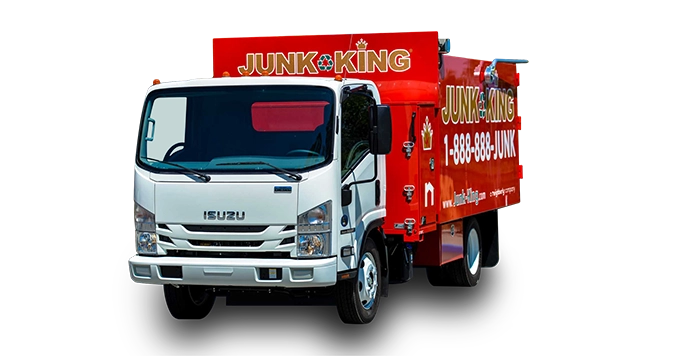
Though it might be easy to separate your coffee grounds from the rest of your trash, what about those large, bulky items that might be harder to recycle? Putting your aluminum cans and junk mail into the recyclable bin is relatively easy, but finding a way to recycle and old refrigerator or a bulky armchair is significantly more challenging for the average person. Enter Junk King of San Carlos. We understand that getting rid of large, bulky junk items can pose a headache for homeowners, especially if you want to ensure that those large items are properly recycled, instead of simply being sent to our local dump. The difficulty of getting rid of old furniture, energy inefficient appliances, and other bulky trash items often means that many resident of San Mateo County end up storing excess “stuff” in their basements, garages, or other odd areas of their home. Other people may resort to illegal dumping or hire a junk removal crew that will simply take those old items directly to the landfill.